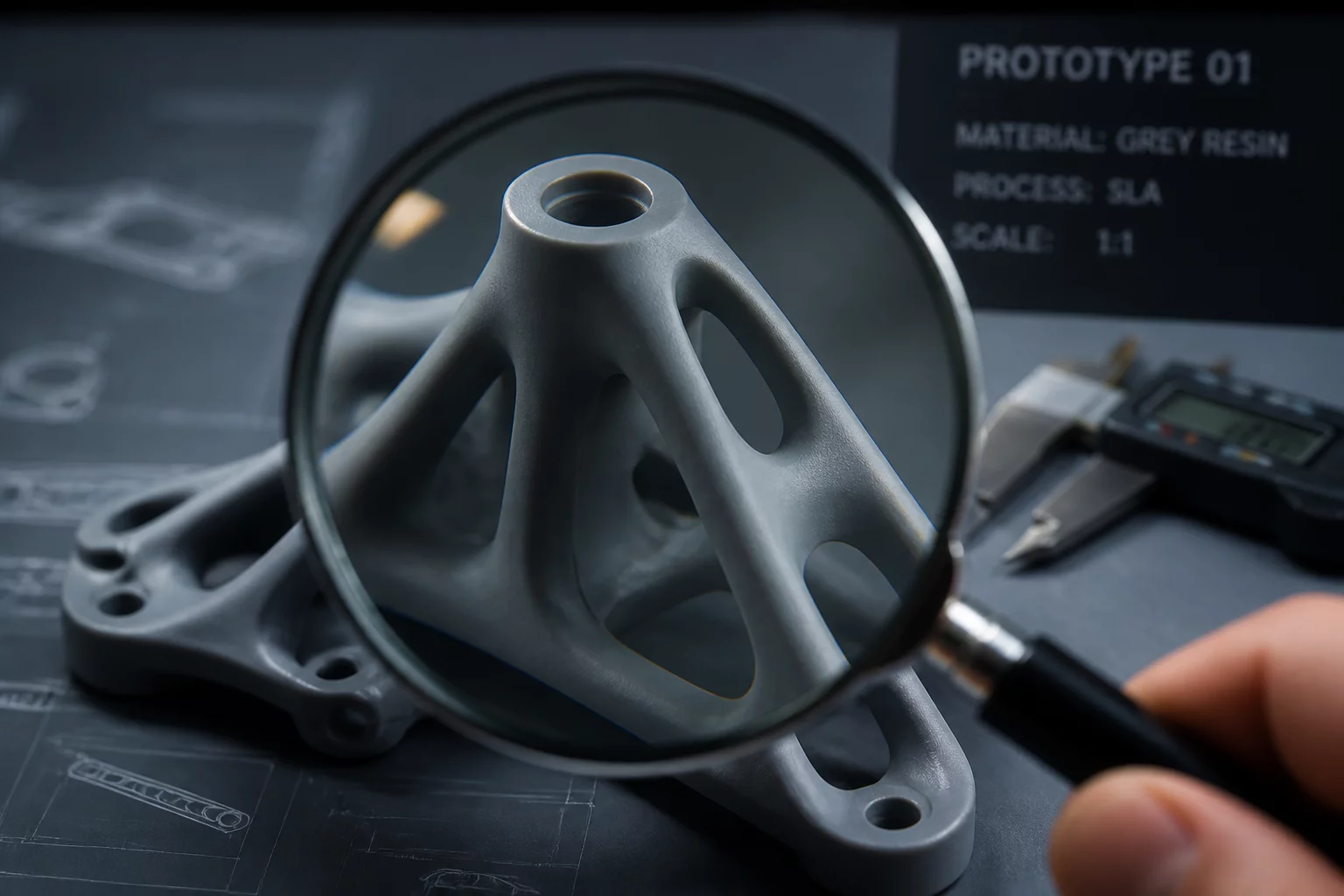
An industry-standard glossary for documenting layer anomalies, cure defects, and finish variances in SLA/DLP 3D printing.
When evaluating the cosmetic and structural quality of cured resin prototypes, teams often struggle with inconsistent language. One person's 'rough edge' is another's 'delamination.' Without standard surface review vocabulary, quality assurance quickly devolves into subjective debates. Establishing a precise glossary allows engineers, designers, and operators to communicate anomalies clearly, accelerating post-processing approvals and reducing unnecessary reprints.
Let us look at the primary terms that describe surface texture variations. Layer striations refer to the visible horizontal lines corresponding to the print's layer height. While always present to some degree, extreme striations suggest Z-axis instability or incorrect exposure times. Another common phenomenon is frosting, which appears as a white, powdery residue on the part. This typically happens when uncured resin remains on the surface during post-curing or when the isopropyl alcohol wash bath has become saturated with dissolved polymer. Orange peel describes a dimpled, uneven texture resembling citrus skin, often caused by uneven heating or fluctuating curing chamber temperatures.
We must also distinguish between various localized defects. Support scarring refers to the raised bumps or recessed pits left behind after supports are detached. Pinholes are tiny, deep voids that occur when air bubbles become trapped in the resin vat during the peel cycle. In contrast, blooming presents as fuzzy, slightly raised patches where uncured resin has partially polymerized on the outer walls due to light bleed or inadequate settling times. By standardizing these terms, operators can rapidly identify root causes in slicing programs like CHITUBOX or adjust physical wash-and-cure parameters without guesswork.
Core Evaluation Objectives
Establishing criteria prior to printing prevents subjective rejection loopbacks. When using unified slicers like CHITUBOX v3.1.0 (or basic editions), clear threshold parameters must align directly with the material characteristics. For instance, high-temperature formulations like Tethon 3D C-Lite require adjusted tolerances due to thermal expansion profiles up to 225 °C.
- Always perform dimensional calibration before batch inspection.
- Maintain uniform post-curing UV distribution to ensure physical integrity.
- Track feature deviations against structural limits defined below.