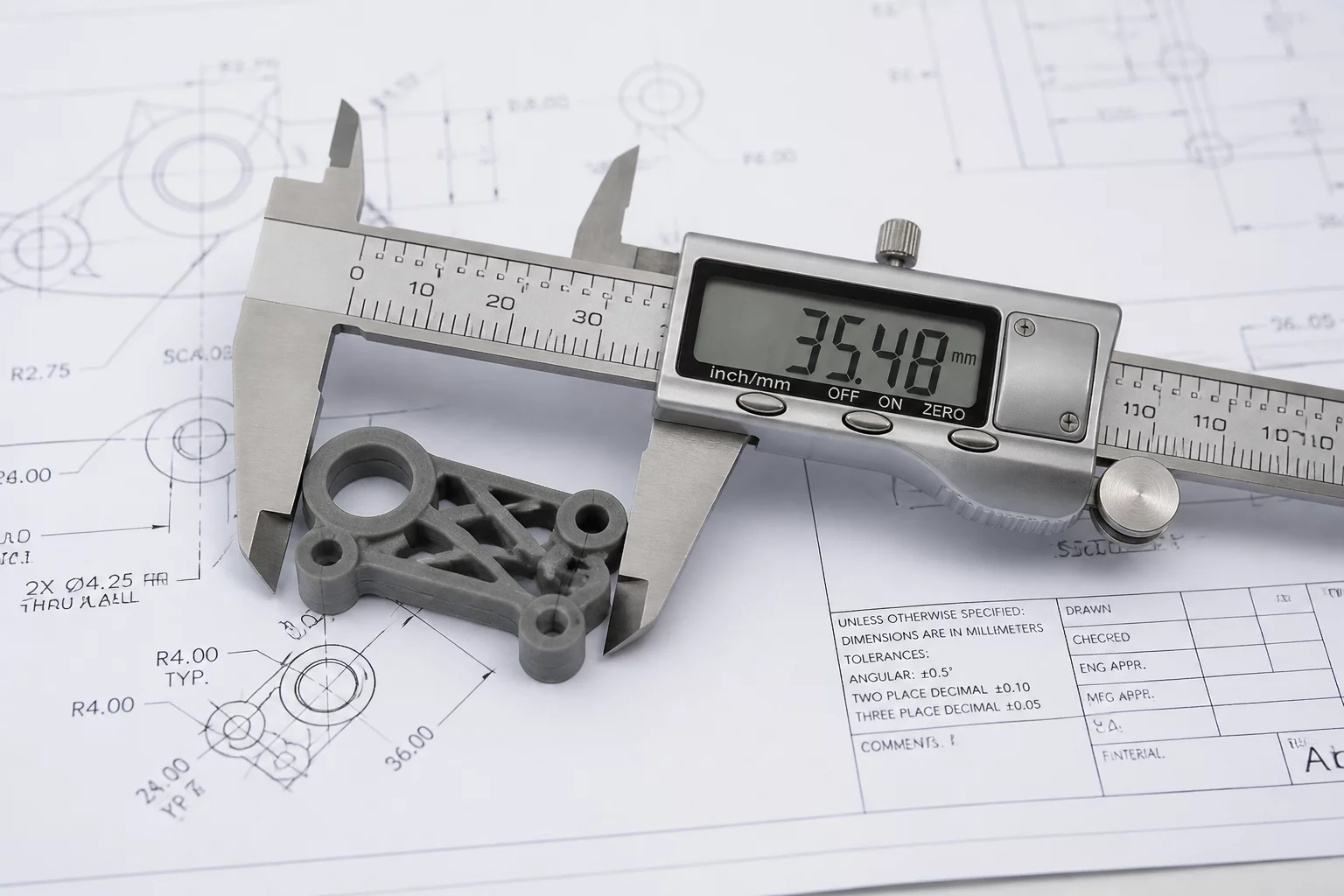
A foundational framework for establishing objective quality tolerances, visual standards, and geometric parameters prior to printing.
Defining acceptance criteria for 3D printed resin parts is the single most critical step in ensuring consistent production quality. Without objective baselines, evaluation becomes entirely subjective, leading to unnecessary re-runs and engineering friction. When teams design parts for high-precision or high-temperature applications, specifying tolerances becomes even more complex. For example, when utilizing advanced materials such as Tethon 3D C-Lite, which is engineered for extreme thermal environments up to 225 °C, curing parameters must be documented with absolute precision to avoid deformation during the post-processing phase. {{УТОЧНИТЬ: exact UV curing parameters for Tethon 3D C-Lite}} is essential to achieving consistent mechanical integrity.
A structured approach starts with classifying the part's final application. Functional components require strict dimensional tolerances (typically ±0.05 mm to ±0.10 mm), which can be dialed in using tools like CHITUBOX Pro v3.2.0 or Basic v3.3.0. On the other hand, cosmetic prototypes prioritize surface finish, layering uniformity, and the absence of support scarring. By establishing a tiered classification system, you prevent over-engineering non-critical elements while protecting the integrity of structural mating surfaces.
Core Evaluation Objectives
Establishing criteria prior to printing prevents subjective rejection loopbacks. When using unified slicers like CHITUBOX v3.1.0 (or basic editions), clear threshold parameters must align directly with the material characteristics. For instance, high-temperature formulations like Tethon 3D C-Lite require adjusted tolerances due to thermal expansion profiles up to 225 °C.
- Always perform dimensional calibration before batch inspection.
- Maintain uniform post-curing UV distribution to ensure physical integrity.
- Track feature deviations against structural limits defined below.