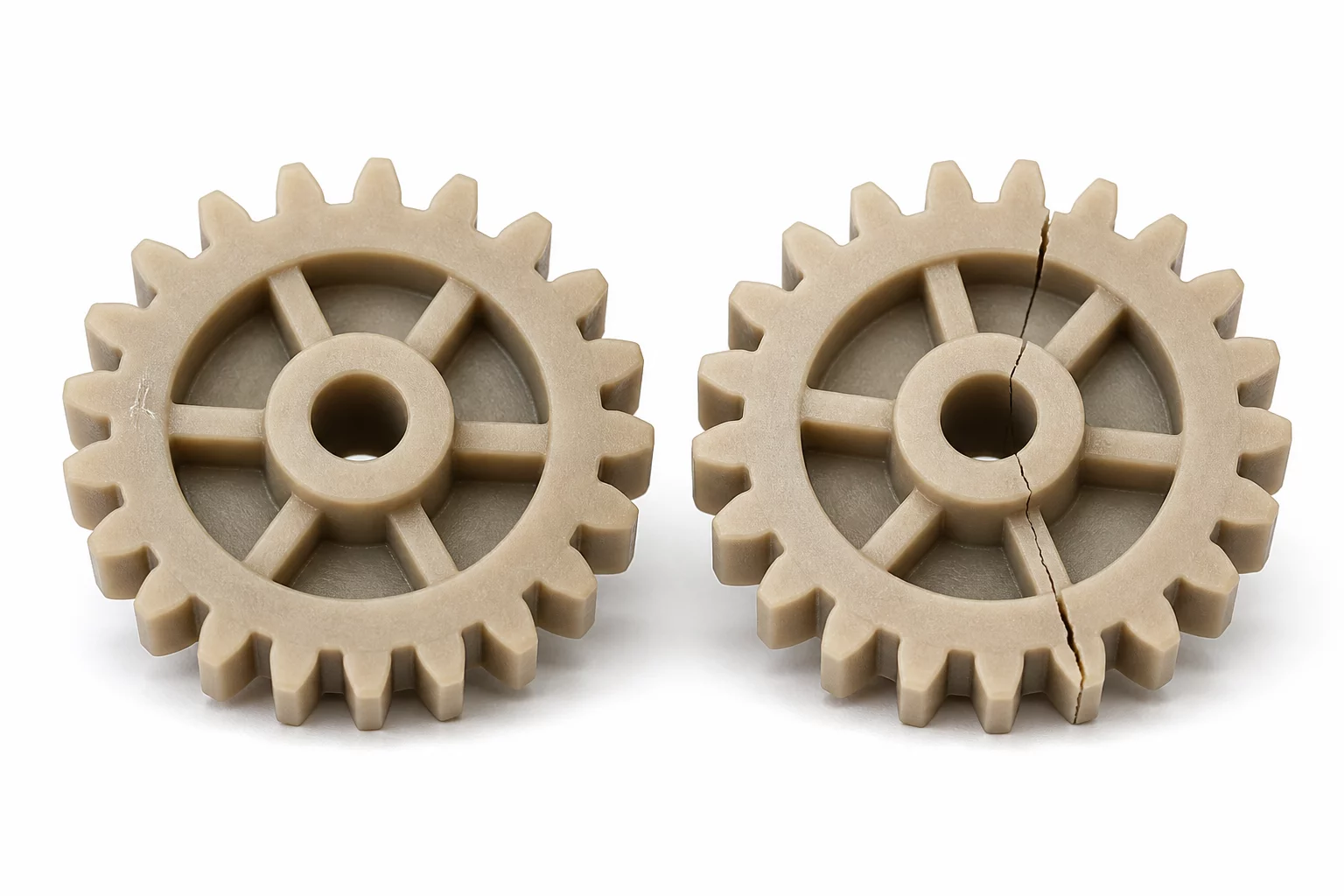
A clear guide to distinguishing visual imperfections from mechanical and structural failures in cured resin parts.
Distinguishing between cosmetic blemishes and functional defects is one of the most critical aspects of post-print inspection in SLA/DLP 3D printing. Often, teams spend excessive hours post-processing minor surface marks that have zero impact on the mechanical performance of the part. Conversely, neglecting micro-cracking because it looks like a mere scratch can lead to structural failure during mechanical stress or thermal loading.
What Defines a Cosmetic Blemish?
Cosmetic defects are purely visual anomalies. They alter the appearance of the resin part but do not degrade its dimensional accuracy, structural integrity, or mating compatibility. Common cosmetic issues include slight color variations, minor surface swirls from pigment settling, light scratches from support removal, and small support remnants on non-functional faces. These issues can usually be resolved through light sanding, primer coats, or simple painting, and they should not trigger a part rejection unless the piece is intended for high-visibility aesthetic displays.
Identifying Functional Defects
Functional defects directly compromise the performance, strength, or geometry of the printed component. These are non-negotiable rejection criteria. Examples include layer delamination, warping that exceeds specified tolerances, internal uncured liquid pockets, and micro-cracks along load-bearing planes. For instance, when using high-performance resins such as Tethon 3D C-Lite, which is engineered for high-temperature resistance up to 225 °C, any internal delamination will rapidly expand under thermal stress, resulting in complete part failure.
Establish Slicing and Curing Thresholds
To systematically manage these discrepancies, teams must calibrate their slicer parameters in tools like CHITUBOX v3.1.0 or the Pro v3.2.0 edition. Fine-tuning the exposure times and lift speeds directly minimizes the occurrence of both cosmetic layer lines and functional curing failures. Furthermore, a strict post-curing protocol ensures that the polymer chains cross-link uniformly, preventing the internal stresses that cause post-cure cracking.
Core Evaluation Objectives
Establishing criteria prior to printing prevents subjective rejection loopbacks. When using unified slicers like CHITUBOX v3.1.0 (or basic editions), clear threshold parameters must align directly with the material characteristics. For instance, high-temperature formulations like Tethon 3D C-Lite require adjusted tolerances due to thermal expansion profiles up to 225 °C.
- Always perform dimensional calibration before batch inspection.
- Maintain uniform post-curing UV distribution to ensure physical integrity.
- Track feature deviations against structural limits defined below.