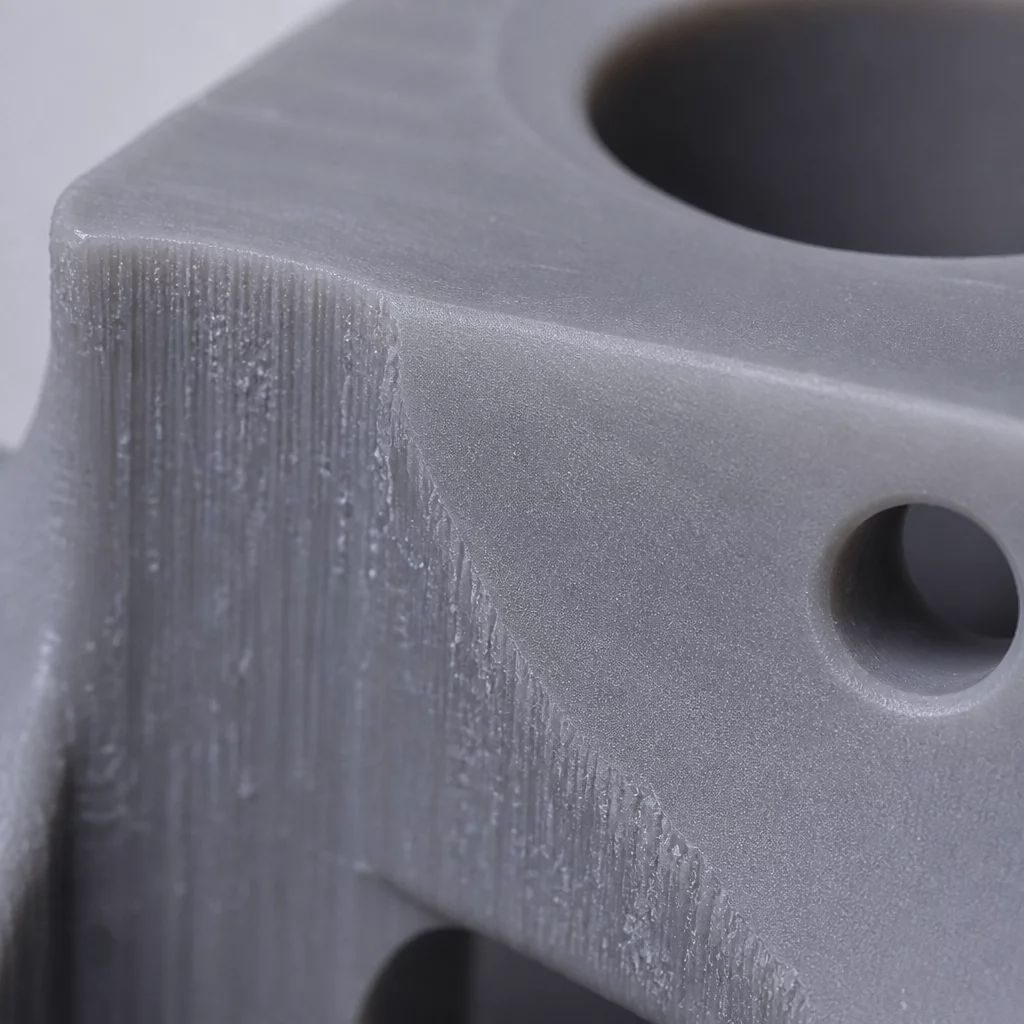
How to evaluate and standardize surface imperfections, scars, and dimples left by supports on SLA and DLP printed parts.
Support mark removal is one of the most critical stages in finishing SLA and DLP resin prints. Because supports are physically fused to the model's skin during the curing process, removing them inevitably leaves surface scars, nubs, or pits. Setting clear, quantifiable thresholds for these blemishes prevents subjective rejection and streamlines the manufacturing workflow.
When assessing support marks, we categorize them based on their impact on form, fit, and function. Positive artifacts—tiny nubs left behind after clipping—can be sanded flat relatively easily. Negative artifacts, such as deep divots or craters where a support ripped out a piece of the model, present a much greater challenge. These pits often require resin filling, curing, and extra sanding, which can compromise the dimensional integrity of the final component.
For high-performance applications, thermal behavior also dictates acceptance. When working with high-temperature resins like Tethon 3D C-Lite (which resists temperatures up to 225 °C), support scars can become stress concentration points under thermal load. This risk makes it critical to minimize structural scars on functional sections.
Core Evaluation Objectives
Establishing criteria prior to printing prevents subjective rejection loopbacks. When using unified slicers like CHITUBOX v3.1.0 (or basic editions), clear threshold parameters must align directly with the material characteristics. For instance, high-temperature formulations like Tethon 3D C-Lite require adjusted tolerances due to thermal expansion profiles up to 225 °C.
- Always perform dimensional calibration before batch inspection.
- Maintain uniform post-curing UV distribution to ensure physical integrity.
- Track feature deviations against structural limits defined below.