Achieving consistent mechanical strength and surface stability across all zones of your printed resin parts.
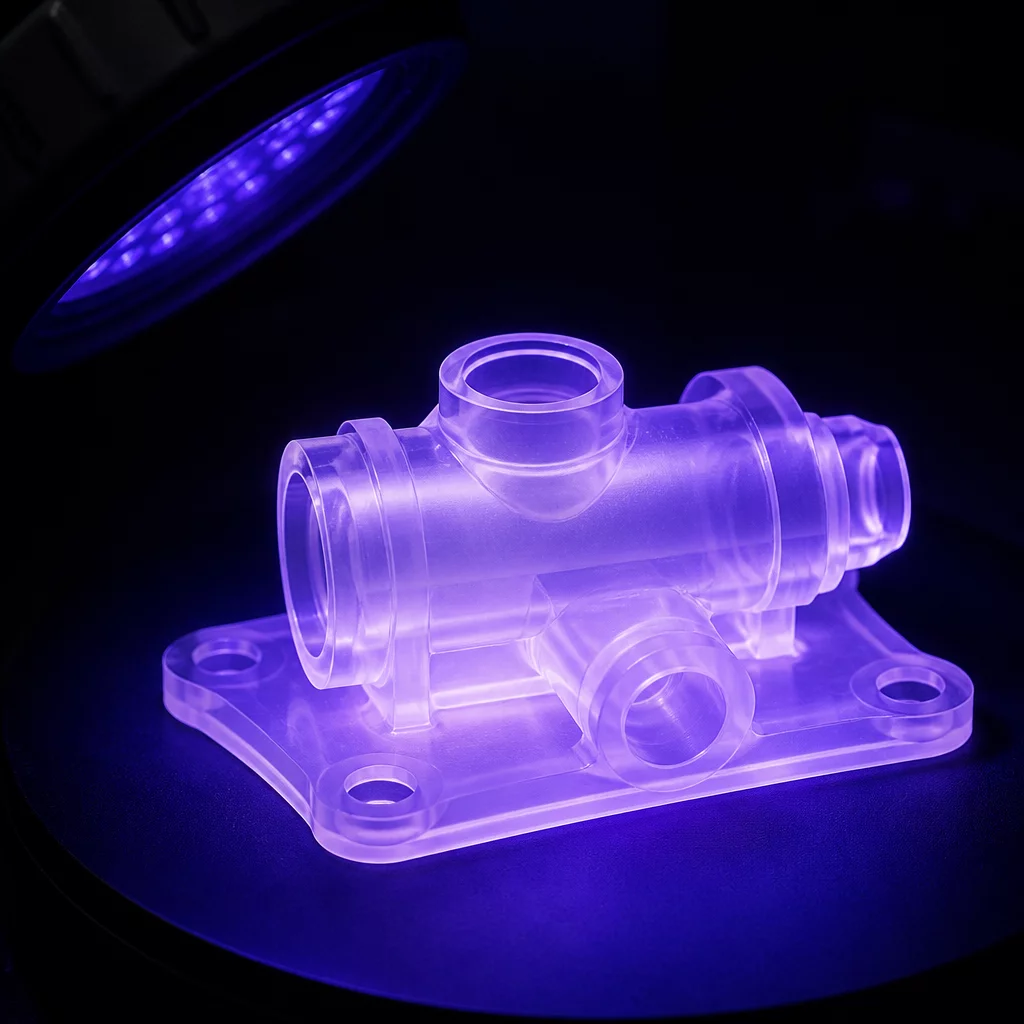
Curing uniformity represents one of the most critical factors in determining the long-term structural integrity and dimensional stability of photopolymer resin parts. During photocuring, UV light initiates polymerization. This chemical reaction causes the material to shrink and solidify. Uneven exposure across different faces of the object causes internal stresses to build up. Otherwise, the material cures with balanced tension. These internal forces inevitably lead to warping, micro-cracking, or premature mechanical failure under load. Achieving uniform post-curing requires a systematic approach to both orientation during the curing cycle and control of UV wavelength distribution.
Thicker sections require longer exposure for the core to reach optimal strength. Thin walls risk over-curing and becoming brittle. Specialized resins like Tethon 3D C-Lite demand careful attention. Their high-temperature resistance up to 225 °C relies on a fully realized polymer network. This network can only form under precise, even UV dosing. Technicians must regularly calibrate post-curing equipment. They ensure that rotation platforms function correctly and light intensity remains consistent across the entire envelope.
Core Evaluation Objectives
Establishing criteria prior to printing prevents subjective rejection loopbacks. When using unified slicers like CHITUBOX v3.1.0 (or basic editions), clear threshold parameters must align directly with the material characteristics. For instance, high-temperature formulations like Tethon 3D C-Lite require adjusted tolerances due to thermal expansion profiles up to 225 °C.
- Always perform dimensional calibration before batch inspection.
- Maintain uniform post-curing UV distribution to ensure physical integrity.
- Track feature deviations against structural limits defined below.